Physical Address
304 North Cardinal St.
Dorchester Center, MA 02124
Physical Address
304 North Cardinal St.
Dorchester Center, MA 02124


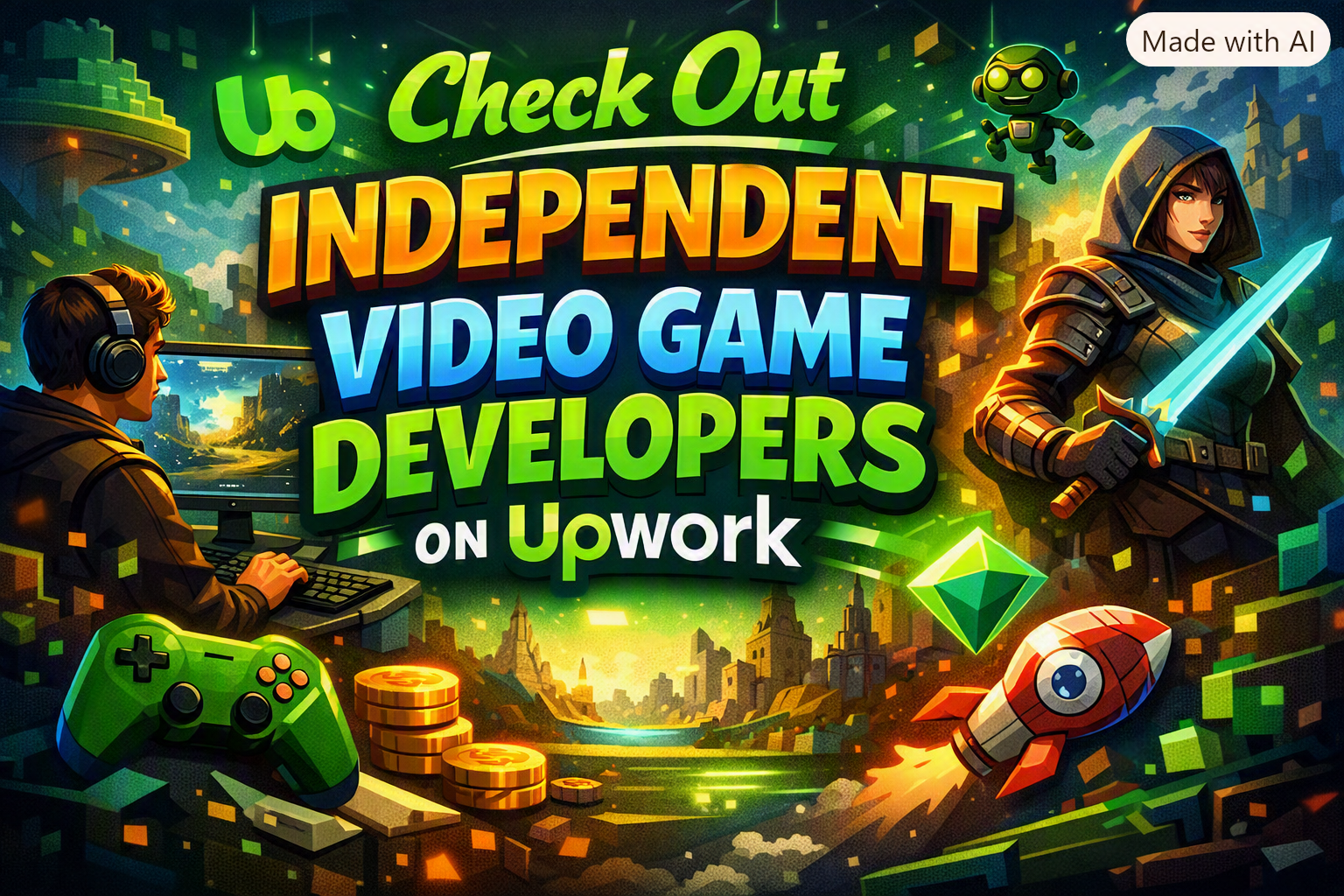
Many people feel nervous about hiring someone online to build a video game. You might worry about losing money, getting unfinished work, or dealing with someone who stops responding.
These concerns are not out of place at all, especially for first-time clients with a dream game idea.
This article fixes that.
It walks through exactly how to find, screen, and commission an independent video game developer on Upwork, safely, successfully, and step by step, so you can move from idea to working prototype without guessing your way through the process.
Whether you’re building a solo passion project or scoping a small commercial title, hiring an independent video game developer is one of the most cost-effective ways to get a game made without hiring a full studio.
The rest of this guide shows you exactly how to do that well.
The question now is:
Yes, commissioning an independent video game developer on Upwork is safe when you use the protections already built into the platform, such as documented work history, milestone-based payments, and on-platform communication.
The risk isn’t the platform itself; it’s skipping the screening steps that protect you.
Upwork is a well-known platform founded in 1998 (later rebranded) and listed on NASDAQ as UPWK.
The platform isn’t some unknown website. It’s one of the largest freelance platforms in the world, connecting businesses with independent professionals across every industry, including game development.
Thousands of clients have successfully used Upwork to commission independent game developers for everything from small prototypes to full indie game builds.
It offers payment protection, dispute resolution, and tools that make remote collaboration possible.
Independent developers on Upwork can offer flexibility and cost-effectiveness that traditional game studios often can’t match.
It offers tools such as secure payments, dispute resolution, contracts, and reviews that enable remote collaboration.
Many indie creators, studios, and businesses have successfully launched games this way.
Most first-time clients worry about paying for work that never gets delivered, or hiring someone who overstates their skills.
Frankly, both concerns are legitimate, and both are addressed directly by Upwork’s milestone funding system and Job Success Score, which we’ll walk through in detail below.
Aside from that, people often ask: Will the developer understand my vision? What if the game has bugs? Can I afford it?
These worries equally make sense. And the good news is that Upwork helps by letting you see the seller’s past work, read honest reviews, and pay in protected steps.
Knowing how to check talent turns these concerns into manageable steps.
A trustworthy independent game developer shows their work. They have a portfolio with playable games or clear demos.
They have positive reviews from past clients. They communicate clearly and ask smart questions about your project.
These indie game developers don’t ask you to pay outside the platform. And they’re willing to start with a small paid test to prove their skills.
They demonstrate professionalism through organized portfolios and realistic timelines rather than overpromising.
Put simply, an independent video game developer is a freelancer, usually working solo or in a very small team, who builds games outside of a traditional studio structure.
An independent video game developer works alone or in a very small group. They handle many parts of making a game without a big company behind them.
Here is what separates the two:
An independent video game developer often wears several hats at once, as they can work alone or in very small teams, which can mean faster turnaround and lower cost, but usually means a narrower scope per project.
While, a studio spreads a project across many specialists: different programmers, artists, designers, and QA testers.
Which one is right for you? That depends on the size and complexity of your project.
Independent developers tend to be the right fit for smaller, well-defined builds rather than massive, multi-year productions requiring dozens of specialists working in parallel.
You need a solo Indie developer if you have a complete game idea and you need one talented developer to build it from start to finish. This is the classic indie game scenario. One developer handles the coding, and maybe some design and art integration.
You need this if you want to test a game mechanic or prove your idea works before spending a lot of money. An independent developer can build a playable prototype quickly and affordably.
Also, this is a good fit for you if you already have a game but need new features, levels, or systems added. A freelance developer can join your project part-time to extend your game’s content.
This expert remains the best option if you built a game for one platform (like PC) and want to release it on another (like mobile or console). An independent developer with porting experience can handle that transition.
You don’t need to be a code guru yourself, but you should at least know what to look for. Here are the key skills that separate a good developer from a great one.
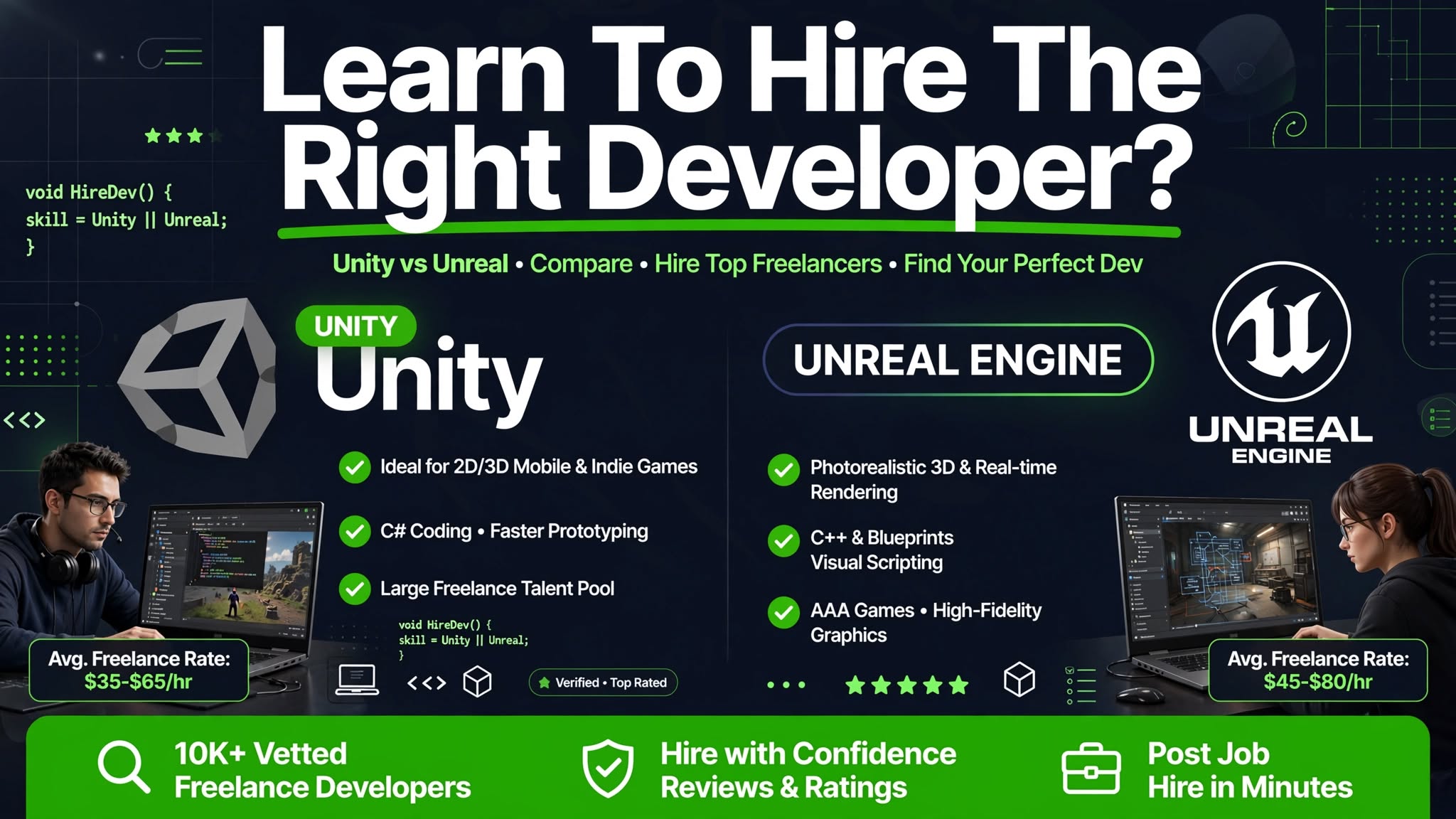
Different game engines require different skills. Know what your project needs:
Most independent developers specialize in one engine. Ask them which they use and why.
Technical skill alone isn’t enough. A great developer understands game design: what makes a game fun, how to balance difficulty, and how to create satisfying player experiences.
These Indie gaming professionals think in systems: how one game mechanic affects another.
This particular skill is non-negotiable, because clear and prompt communication matters as much as technical skill on a remote project.
A developer who explains tradeoffs and flags problems early is far easier to work with than one who goes quiet between updates.
A developer worthy of being hired should send regular updates, ask clarifying questions, and be easy to reach. Good communication prevents costly misunderstandings.
A portfolio is a developer’s resume. So, don’t just look at pretty screenshots you see and click the order button.
Whether you’re hiring someone for an NFT Game Developer for Web3 or for a game animation, play their games if you can. Check if they’ve actually shipped titles and completed games that players can download or play.
Prioritize developers who can point to actual published or playable work, ideally with player feedback or reviews you can check independently. A history of shipped games shows they can finish what they start.
Finding the right developer for your Indie game is a process. Follow these steps religiously to get it right.
This is the most important step, and you don’t need to toil with it.
Before you post anything, write down exactly what your game is, what features it needs, what platforms it’s for, your budget, and what your timeline looks like.
A clearly scoped project attracts developers who are genuinely qualified, rather than a flood of generic applicants.
Upwork’s filters are your best friend, as it helps you filter by:
Don’t just search “game developer.” Search terms like “Unity developer,” “Unreal developer,” or “Godot developer” will attract people with the exact skills you need.
A developer who knows C# and Unity might not be the right fit for a C++ Unreal project.
This aspect of looking for an Independent Game Developer for hire can determine the quality of game you get.
That’s why you’ve to narrow your list to three to five developers with relevant portfolio work and strong reviews before you start messaging anyone.
Comparing a small shortlist side by side beats reading fifty open proposals.
Let me break down the shortlisting process further.
You’ve found some promising candidates, haven’t you? Now it’s time to actually commission them.
Here’s our proven step-by-step process.
A good job post gets good proposals, and there’s no shortcut to it. Include:
When proposals arrive, don’t just read the first one. Compare 5-10 candidates. Look for:
Before committing your full budget, commission the developer for a small, clearly scoped task like building a single game mechanic or fixing a simple bug. This is a low-cost way to evaluate their skills and working style with minimal risk.
Pro Tip: Treat the trial task like a real project, with a clear deliverable and deadline. How a developer handles a small task tells you a lot about how they’ll handle a bigger one.
Break a larger project into stages: prototype, core mechanics, art integration, polish and testing, and fund each milestone separately. This keeps both sides accountable and gives you natural checkpoints to catch issues early.
Use Upwork’s milestone system to break the project into phases:
Once you’ve chosen a developer, document the agreed scope, timeline, and payment terms directly in the Upwork contract.
That’s not all. Make sure the scope of work is clearly defined: what’s included, what’s not, and what happens if things change.
A written record protects both parties if a disagreement comes up later.
Ready to put this into practice? Start hiring on Upwork today and post a clearly scoped job for your project using the steps above.
Knowing what to avoid is just as important as knowing what to look for. Watch for these warning signs.
If a developer offers to build your game for a fraction of what others are quoting, be very suspicious. Quality work costs money. Low bids often mean low quality, stolen assets, or someone who will disappear mid-project. Upwork’s median rate for game developers is around $28 per hour.
A portfolio with only screenshots or concepts is a massive red flag. A serious developer has playable demos or shipped games they can show you. If they can’t prove they can finish a game, don’t trust them with yours.
This is also worth mentioning. A proposal that doesn’t reference your specific project was likely sent to dozens of unrelated job posts the same day—move on.
A good developer will read your job post carefully and write a custom response that shows they understand your project.
Important: Upwork’s terms require you to keep communication and payments on the platform.
If a developer asks you to chat outside Upwork or pay via PayPal or wire transfer, that’s a major red flag. That request removes every protection this article describes
It means you’ve no access to escrow, dispute process, and recourse.
Stay on Upwork to stay protected.
Cost is always a top concern for some people thinking of hiring an Independent Video Game Developer. Here’s what you need to know before opening your wallet.
Rates depend on several things:
Which is better?
This is a top-secret tactic that I often use when hiring freelancers for my clients.
I always have in mind that a slightly higher rate from an experienced independent video game developer often finishes faster and needs less rework, and usually costs less overall than a cheaper hire who requires constant correction.
You want the best value for your budget.
For instance, a developer who charges $40/hour but delivers polished, bug-free code is often cheaper in the long run than someone who charges $15/hour and leaves you with a broken game.
Look at portfolios and reviews, not just the price.
Upwork isn’t just a job board. It has specific features designed to protect clients.
For fixed-price contracts, funds are held in Upwork’s project-funds system (formerly called escrow) before work begins, and released once you approve the completed milestone, or automatically after a 14-day review window if you take no action.
. If the developer doesn’t deliver on time, you can dispute the milestone.
For hourly contracts, developers use the Upwork Desktop App. It takes screenshots and records activity levels.
You can review the Work Diary to see what they worked on and when. This protects you from paying for idle time.
As mentioned earlier, if a project goes bad, Upwork offers dispute resolution. You can work with a mediator to find a fair solution. It’s not perfect, but it’s a safety net you don’t have when hiring off-platform.
Hiring a developer is just the beginning. How you manage the relationship can go a long way in determining the project’s success.
Experienced hirers start with a Game Design Document (GDD). Thus, copy their strategy by writing down everything: the core loop, the characters, the levels, the mechanics.
This becomes the roadmap for your developer. Without it, you’re asking them to guess what you want.
In addition, documenting your creative vision and technical requirements up front removes any ambiguity about what “done” looks like for each milestone.
Ask your developer to use version control (like Git) for code and assets. This means you’ll always have access to the latest version.
Also, ask for regular build reviews—playable versions of the game you can test and provide feedback on. Small issues are far cheaper to fix early.
Feedback is essential, but be careful about “scope creep,” which means adding new features mid-project.
For the best result, it has to be borne in mind that every new feature takes time and costs money.
So, you’ve to give specific, actionable feedback tied to what was originally agreed upon, and treat any new requests as a scope change with its own timeline and cost, not a free add-on.
If you want to add something, discuss it with your developer and adjust the budget and timeline accordingly.
Once you find an independent video game developer who delivers well, keep working with them on updates, patches, and future projects because they’ll already understand your codebase and creative direction.
A trusted long-term partner is incredibly valuable in game development.
Rather than searching from scratch, you can browse Upwork’s talent pool directly for independent video game developers filtered by engine, rate, and Job Success Score.
Look for developers with published, playable work and detailed client reviews that mention projects similar in scope to yours; that combination is the strongest signal of a reliable hire before you ever send a message.
Ready to start? Here are some Upwork profiles of independent game developers with proven track records carefully recommended for you.
Profile to feature (example):
Unity Expert with 5+ Years of Experience
Hire a Unity developer who has shipped 3 mobile games and has a 100% Job Success Score. Specializes in 2D platformers and mobile optimization. Rates start at $40/hr.
Unreal Generalist
Go for an Unreal developer with experience in both code and environment art. They must have worked on two published indie titles. Rates start at $55/hr.
Godot Specialist
We recommend a Godot developer dedicated to the open-source Godot engine. They should’ve built prototypes and full games for multiple clients. Rates start at $30/hr.
Always check a freelancer’s current availability and latest reviews before hiring. Rates and skills can change.
Final Thoughts: Commission the Right Independent Video Game Developer With Confidence
You now have the knowledge to move forward confidently. Upwork is a legitimate platform that has helped countless clients commission independent video game developers.
The risks are real—but they’re manageable. By following the steps in this guide. including defining the scope, checking their portfolios, starting small, and using milestones, you lower risks and increase chances of finding the right person to build your game.
A Quick Checklist Before You Hire
Next Steps to Start Your Project on Upwork
The gap between a smooth game project and a frustrating one usually comes down to how carefully you screen and structure the hire, not luck.
Use the checklist above, and when you’re ready, start hiring on Upwork today to commission your next independent video game developer with confidence.
How Do I Commission an Independent Video Game Developer for a Small Project?
Start by writing a clear job post describing the small task—like a bug fix or a simple prototype. Set a fixed budget. Ask for a portfolio. Start with a small paid test. A small project is a low-risk way to find a developer for a larger game later.
What’s the Difference Between Hiring a Solo Developer and a Studio?
A solo developer handles everything themselves: code, design, art integration, and sometimes testing. They’re cheaper and more flexible but limited by one person’s time. A studio provides a team with specialized roles—artists, coders, designers, QA—and can handle bigger, more complex projects. Studios also cost more.
How Long Does It Take to Build an Indie Game With a Freelancer?
It depends entirely on the game’s complexity. A simple 2D platformer might take 1-3 months. A complex 3D RPG could take a year or more. The timeline should be discussed and agreed upon before the contract starts.
Can One Independent Developer Handle Art, Code, and Design?
Some developers are “full-stack” and can handle all three, but they’re rare. Most specialize in one area. For a game with custom art, you might need to hire a separate artist. Be realistic about what a single person can deliver.
Is It Better to Hire One Developer or a Small Team?
For small, simple projects, one developer is often enough. For larger, more ambitious games, a small team (like 2-3 freelancers working together) might be a better fit. You can also hire a developer who collaborates with trusted freelancers for art and audio.