Physical Address
304 North Cardinal St.
Dorchester Center, MA 02124
Physical Address
304 North Cardinal St.
Dorchester Center, MA 02124


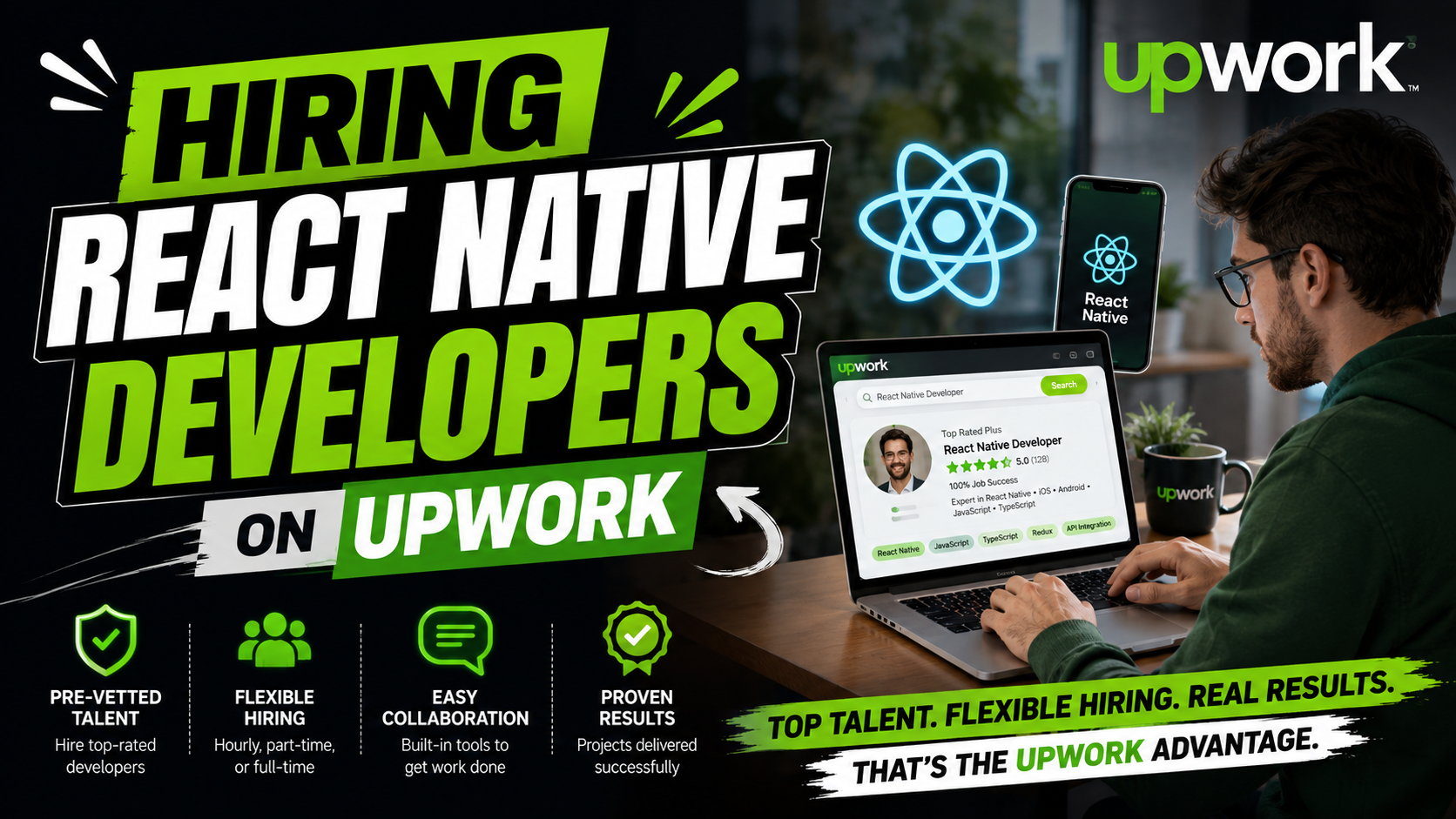
Hiring React Native developers can sometimes feel very overwhelming, especially if you don’t know where to start.
You need a developer who understands cross-platform nuances, writes clean code, and can deliver on time.
After spending weeks analyzing the platform’s latest hiring workflows and interviewing multiple freelancers for my clients, it is clear that Upwork offers a unique combination of scale and structure for this specific need.
This evaluation is based on a review of the platform’s search algorithm, proposal system, and the profiles of top-tier talent.
This guide is for decision-makers who need to move fast and want a clear, actionable path to hiring React Native developers without the overhead of a traditional recruiting firm.
Who This Is For
This guide is for startup founders, product managers, and small business owners who need a mobile app built or maintained and don’t have an in-house engineering team.
It’s also useful if you already have one developer and need to scale up quickly without a long hiring process.
Who Should Skip It
It’s probably not for you if you’re building a huge, security-critical enterprise app (think banking infrastructure) that legally requires an in-house, background-checked team.
Skip this if your project demands strict security clearances that limit remote work, or if you already have a trusted long-term development partner.
In those cases, freelance marketplaces are still worth knowing about, but they may not be your first stop.
The demand for React Native expertise isn’t just a trend; it is a strategic response to business efficiency needs.
Companies are realizing that maintaining two separate codebases for iOS and Android is expensive and slow.
That’s why React Native solves this by allowing a single team to build for both platforms simultaneously. This has made the skill set one of the most sought-after in the tech industry.
Ten years ago, building a mobile app usually meant building it twice, once in Swift for iOS, once in Java or Kotlin for Android.
That doubled the cost and the timeline. React Native changed that by letting developers write one codebase that runs on both platforms, which is why demand for the skill has climbed steadily every year since.
Businesses no longer have to choose between reaching iPhone users and reaching Android users. That single shift is a major reason hiring React Native developers has become a priority for so many companies, from early-stage startups to large retail brands.
This evolution means businesses no longer have to choose between reaching users on both major operating systems or staying within budget.
Upwork sees job posts for every type of project.
Most companies turn to React Native for a handful of common situations: launching a minimum viable product (MVP) fast, rebuilding an aging native app without doubling the engineering team, or adding new features to an app that already uses React Native.
Mobile apps for ecommerce apps, fitness trackers, fintech tools, and booking platforms are not left out, as they’re especially common use cases, since all of them need to feel fast and native on both major mobile operating systems.
Others look for help creating a complex customer-facing application for a delivery marketplace. There is also a heavy demand for experts to upgrade existing legacy apps to newer versions of React Native, specifically the New Architecture (Fabric and TurboModules).
The common thread is a need for speed and cross-platform reach.
The reason is simple to comprehend.
A native iOS and Android team usually means two sets of engineers, two codebases, and two timelines to manage.
Instead, hiring React Native developers means one team, one codebase, and, in most cases, a faster path to launch. It allows you to cut your development team size in half compared to running separate iOS and Android teams.
That efficiency is exactly why the skill shows up so often in job posts for early-stage products that need to move quickly on a limited budget.
Companies also choose to hire react native developers over native teams because it helps reduce the complexity of project management and feature synchronization.
It allows startups to launch faster and enterprises to iterate more efficiently on their digital products.
Before you post a job, you need to know exactly what you are looking for. There are specific technical skills and red flags that can make or break your project.
Being smart enough and taking the time to define these requirements upfront will save you from costly mistakes.
A solid React Native developer should be comfortable with JavaScript or TypeScript, the React Native framework itself, state management tools like Redux, and navigation libraries like React Navigation.
They should also understand how to connect an app to a backend through REST APIs, push notifications, user authentication systems, or GraphQL.
They should also know how to work with tools like Firebase for authentication and real-time data.
Just as important is experience with the native build process; knowing how to get an app through the Apple App Store and Google Play Store review process, since that step trips up a lot of first-time app owners.
They also need specific mobile development skills. Hence, look for experience with Expo or React Native CLI.
A solid grasp of native build tools (Xcode, Android Studio) is non-negotiable, too.
In the freelance world, the portfolio is your best vetting tool. Avoid developers who cannot show you at least two published apps on both the Apple App Store and Google Play.
Aside from that, be wary of those who only have “tutorial” projects or apps with poor user experience.
Rather, look for a track record of maintaining and updating apps, not just building them from scratch.
If they are vague about their specific contributions to a complex project, it is often a sign they were merely a small part of a larger team.
Upwork offers all three options. For a one-off project with a clear scope, an individual freelancer is usually sufficient.
For larger, more complex builds requiring multiple skill sets (like design, backend, and QA), an agency might be a better fit. An agency, like the SolidAppMaker group, offers a full team structure with a project manager, but it comes at a premium.
The “right” model depends entirely on your budget and project complexity. For most startups, hiring a single, highly skilled React Native developer on Upwork is the most efficient start.
The unique thing about Upwork is that it reduces the friction associated with traditional hiring.
Once on the platform, you are not dealing with recruitment agencies, scheduling dozens of initial phone screens, or managing payroll for contractors.
It’s deliberately built to handle the logistics so you can focus on the quality of the work.
Upwork’s talent pool spans dozens of countries, which means you’re not limited to hiring only within your own city or time zone.
This scale gives you access to developers with a wide range of experience levels, from junior coders to experts who have generated over $10 million in client revenue.
As one review noted, you can find amazing devs, but the quality varies widely, so you must spend time vetting.
The sheer volume means you are unlikely to run out of options.
Upwork’s transparency is its greatest asset. Every Upwork profile shows a Job Success Score, total hours worked, total jobs completed, and detailed client feedback on past projects to see if they deliver on time and communicate effectively.
Instead of relying on a resume alone, you can see exactly how a developer has performed on real projects, with real clients rating the outcome.
For instance, a developer with a 100% Job Success Score and over 6,000 hours of tracked work has a proven track record.
That level of transparency is hard to find anywhere else.
This is another big advantage of using Upwork to hire a freelance React Native Developer
The platform supports virtually any engagement model. This means you can hire on an hourly basis for a weekly retainer, or set up a fixed-price project for a specific deliverable.
This flexibility is essential for businesses that need to scale up or down quickly. If you need a developer for a short-term bug fix, you can do that easily.
What if you need a long-term partner? That is possible too. Many clients prefer fixed-price contracts for clear deliverables like “Build an MVP” to manage their cash flow.
The following section is a tactical blueprint. It walks you through the specific steps to go from posting a job to receiving the final product with minimal risk. Following this process is the most reliable way to ensure a successful hire.
Your job post is your sales pitch, so make it stand out and easy to understand. The best candidates will only spend a few seconds reading it before deciding to apply.
Be specific. Instead of “need an app built,” describe the features, the target platforms, your timeline, and your budget range.
Begin with a clear project title, like “React Native Mobile App Developer for Delivery Platform.” Be clear about your tech stack: “Need experience with Expo, Firebase, and Stripe integration.”
Job posts that mention specific tools- Expo, Firebase, Redux- attract developers who already have exactly that experience, which saves you time in the screening stage.
Don’t forget to include a “Must-Have” section that lists absolute requirements, such as published apps. A clear scope and budget will filter out 80% of unqualified applicants.
When the proposals begin to land, as I expect you likely receive dozens. Look past the price and read how each proposal mentions and addresses your specific project needs, the client feedback, and Job Success Score first.
Are they Top Rated Plus? Have they completed similar projects before? Next, read the proposal for attention to detail.
A generic, copy-pasted proposal is a signal to move on. A proposal that references your app’s specific requirements shows the developer actually read your post.
Shortlist only those who genuinely seem to understand your goal.
For fixed-price projects on Upwork, the escrow system is critical. You must fund the milestone before the developer starts working.
The money is held securely by Upwork and only released to the freelancer when you approve the work.
This protects you from paying for incomplete or faulty code, and protects the developer from doing the work and never getting paid.
Never pay a freelancer outside of the Upwork system or release a milestone before you have tested the output.
Break your project into logical phases. A typical mobile app project might have milestones for: 1) Project setup and architecture,
2) UI/UX implementation,
3) API integration, and
4) Beta testing and bug fixing.
This structure ensures that you are not committing the full budget until critical parts of the app are delivered and working. It also gives the developer clear targets to hit.
To curtail any form of hiccup, set regular check-ins. Schedule a weekly 15-minute sync to review the progress against the roadmap, and use a channel like Slack or Microsoft Teams for quick updates.
For tracking code, the developer should use Git (GitHub or GitLab). There’s every need for you to have access to the repository from day one.
This allows you to monitor progress and ensures you own the codebase even if the contract ends.
Clear, consistent communication is often the single biggest factor in whether a remote engagement succeeds.
Once you shortlist candidates, conduct a technical interview. Do not ask trivia questions. Focus on problem-solving.
Ask candidates to walk you through a past React Native project, including a technical decision they made and why.
You can also ask them to share their screen and do a small live coding exercise, like creating a simple component or troubleshooting a common error.
Upwork also supports skill tests and allows you to request a short paid trial task, which is a low-risk way to confirm someone’s skills before committing to a full project.
This is the most effective way to gauge their actual skill level.
Once you’ve chosen a developer, Upwork generates a contract that documents the scope, payment terms, and milestones you agreed on.
This written record protects both sides if there’s ever a disagreement about what was promised.
For fixed-price projects, define the deliverables for each milestone clearly.
The point is that the more specific you are, the less room for dispute. If you prefer hourly contracts, set a weekly maximum to avoid bill shock. Once the offer is sent, the freelancer will accept, and your work officially begins.
If you’d rather skip the search and go straight to proven talent, here are two Upwork freelancers worth a look, based on their public track records.
Freelancer 1: SolidAppMaker (Daisy VC)
Stephanie C. (SolidAppMaker) runs an agency with over ten years of combined experience in Android, iOS, and cross-platform development, and has completed 257 jobs on Upwork with a 100% Job Success Score and a 4.7-star rating across 129 reviews.
She holds Top Rated Plus status, has logged nearly 6,800 hours on the platform, and works at $40/hour.
Her team has shipped apps across healthcare, fintech, e-commerce, and logistics, and clients consistently mention clear communication and on-time, on-budget delivery.
If your project needs both mobile development and broader full-stack support, think backend APIs, third-party integrations, or App Store submission, her profile is worth a conversation, and she offers a free consultation to scope your project before you commit.
Key Stats:
Check Out SolidAppMaker Profile For More Details
Freelancer 2: Yaroslav D.
Yaroslav D. brings over 20,000 hours of hands-on React Native and full-stack engineering experience, with 42 completed jobs, a perfect 5.0 rating across 20 reviews, and Top-Rated Plus status at just under $40/hour.
His background includes React Native, Expo, Firebase, and WebRTC work across fitness, fintech, and consumer app products, and clients specifically call out how invested he is in the long-term success of the product, not just finishing the task list.
For founders who want a developer who can think about the product as a whole, not just write code to spec, his profile stands out.
Both are strong starting points if you’d rather hire a proven developer than sort through dozens of cold applications yourself.
Key Stats:
Check Out Yaroslav D.’s Profile for More Details
The platform’s infrastructure is designed to reduce the risk of remote work. It provides layers of protection for both parties, which builds trust in a transactional environment.
Beyond fixed-price escrow, Upwork’s Hourly Protection covers work logged and verified through the platform’s time tracker, so you’re only paying for hours that are documented and reviewable.
It means the freelancer is guaranteed payment if they deliver the work as agreed, and you are protected if they don’t.
You only release the funds after you have reviewed and approved the submission. This creates a fair system where the freelancer is incentivized to deliver quality work.
If you are paying by the hour, Upwork’s time tracker captures periodic screenshots and activity levels during such tracked hours, giving you visibility into how time was spent without requiring you to micromanage the developer directly.
The app takes random screenshots of the freelancer’s screen and tracks mouse and keyboard activity.
This provides a verifiable record of work performed. While some developers dislike the “Big Brother” feel, for a client, it is the only way to ensure you are paying for actual work and not just a timer.
Disputes happen, even with good intentions from both the seller and buyer. Upwork offers a formal dispute resolution process, which allows them to mediate if the deliverables don’t match the contract or if there is a disagreement about quality.
This mediation serves as a safety net that most freelance arrangements found outside a platform simply don’t have.
It is not perfect, but it offers a structured process, unlike paying someone via PayPal or a bank transfer. 24/7 support is available to help manage issues when they arise.
Cost is often the primary concern. On Upwork, the price range is wide, from budget-friendly junior developers to enterprise-level experts.
Hiring React Native developers on Upwork can range anywhere from $25 to $100 per hour. Developers from regions with a lower cost of living may charge toward the lower end of that spectrum.
Top-tier experts, like those with Top Rated Plus badges, often command rates between $40 and $80 per hour.
You generally get what you pay for; developers with a proven track record of revenue generation or working with 9-figure businesses will charge a premium.
If the scope is well-defined, a fixed-price contract is usually the best choice. It eliminates the risk of cost overruns.
For example, a job posting might be fixed at $3,000 for the entire project. However, if the project is exploratory or likely to change, an hourly contract is safer, because it allows for flexibility and iteration without renegotiating the price every week.
To get a solid App built and delivered based on your specifications, don’t automatically choose the lowest bidder.
Look to hire a developer who offers the best balance of experience, skill, and price. To get good value, be very clear in your job post. A vague brief will attract vague bids.
A slightly higher hourly rate from an experienced developer often finishes faster and requires less rework, which usually costs less in total.
Always check Job Success Score, read a handful of their full reviews, and star ratings before thinking of placing an order.
Also, consider hiring developers in a similar timezone to reduce communication lag. This reduces project risk and often yields a better ROI.
It’s now time to shift our attention to specific use cases that help illustrate how the platform solves real business problems.
A startup had an idea for a same-day delivery marketplace. They did not have months to wait for hiring an in-house team. They posted a job on Upwork for an experienced React Native developer to build a customer-facing app.
They connected with a freelancer who built the app in just eight weeks, integrating Supabase and Stripe. The app allowed them to launch their MVP and test the market with minimal upfront investment.
An existing software company had a web-based SaaS product for workforce management. They wanted to build a mobile app to complement it.
They hired a senior React Native developer to build the app from the ground up, focusing on features like offline capability, push notifications, and complex scheduling.
The developer integrated the app with their existing Node.js backend, significantly boosting user engagement for their B2B clients.
Upwork, like every other freelancing platform, is not perfect, and it’s worth knowing the friction points before you think of hiring a developer.
Upwork charges freelancers a service fee, which sometimes gets factored into the rate they quote you, so top talent can occasionally cost slightly more than working with someone directly.
The sheer volume of proposals on a popular job post can also be overwhelming if your listing isn’t specific enough; expect to spend real time screening.
Time zone differences can slow down day-to-day communication if you’re not intentional about setting overlap hours.
And while Upwork’s vetting signals (Job Success Score, Top Rated status) are genuinely useful, they’re not a substitute for your own screening; a high rating means a developer performed well on past projects, not that they’re automatically the right fit for yours.
None of these are dealbreakers, but going in with clear eyes about them will save you frustration later.
A successful hire is not just about the first project; it is about building a relationship. Managing a remote developer effectively is key to long-term success.
At the start of the project, define your preferred communication method. Set up a daily or weekly stand-up to avoid silos.
Have a clear way to share feedback. Successful profiles often cite “clear communication” as a primary reason for a positive experience.
Using a tool like Figma for design feedback and GitHub for code reviews keeps everyone on the same page.
Adopt an Agile methodology like Scrum or Kanban. This means breaking down work into two-week sprints and prioritizing tasks in a backlog.
This allows you to adjust priorities as your business needs change. It also provides a clear framework for measuring progress and ensures the developer is always working on the highest-value tasks.
Once you’ve found a React Native developer you trust, Upwork makes it straightforward to bring on additional freelancers for design, QA, backend work, or a front-end developer, letting you build out a full remote team without leaving the platform.
This means you can hire a second developer to handle specific features, or hire a UI/UX designer to support the React Native developer.
Building a network of reliable freelancers allows you to expand your engineering capacity without the long-term commitment of full-time employees.
Hiring React Native developers doesn’t have to mean rolling the dice on a stranger’s resume.
Upwork’s combination of verified work history, transparent client reviews, escrow-protected payments, and flexible contract types gives you far more visibility and protection than hiring outside a platform.
Between the global talent pool, the built-in safeguards, and proven freelancers like Stephanie C. and Yaroslav D. already delivering results for other businesses, Upwork remains one of the most practical places to start your search when you’re ready to hire a React Native developer for your next project.
Whether you need a quick MVP or a scalable enterprise app, Upwork is the most reliable starting point for your mobile development journey.
The key to success is spending time vetting candidates and setting clear expectations, but the platform offers the infrastructure to do that effectively.
How long does it take to hire a React Native developer on Upwork?
In most cases, you can be interviewing developers within 24 hours of posting a job. Finding the “right” developer for your specific project might take 2-5 days to allow for proper vetting and interviewing.
Can I hire a React Native developer for a short-term project?
Yes. Upwork supports short-term, project-based engagements. You can post a job with a fixed price that covers a specific deliverable (like a bug fix or a new feature). You are not locked into a long-term commitment.
Is Upwork safe and reliable for hiring developers?
Yes, Upwork is a safe and reputable platform. It uses an escrow system for fixed-price contracts, offers time-tracking for hourly contracts, and provides a formal dispute resolution process. The platform also handles all invoicing and payments, making it easier to manage contractor expenses.
How much do React Native developers charge on Upwork?
Rates typically range from $25 to $100+ per hour, depending on the developer’s experience and geographical location. The average rate for skilled developers is between $40 and $60 per hour.
What skills should I look for when hiring a React Native developer?
Look for expertise in React Native and React.js, knowledge of native platform tools (Xcode and Android Studio), experience with state management libraries like Redux, and integration with REST APIs or Firebase. It is also crucial to confirm they have launched apps to both the Apple App Store and Google Play.