Physical Address
304 North Cardinal St.
Dorchester Center, MA 02124
Physical Address
304 North Cardinal St.
Dorchester Center, MA 02124


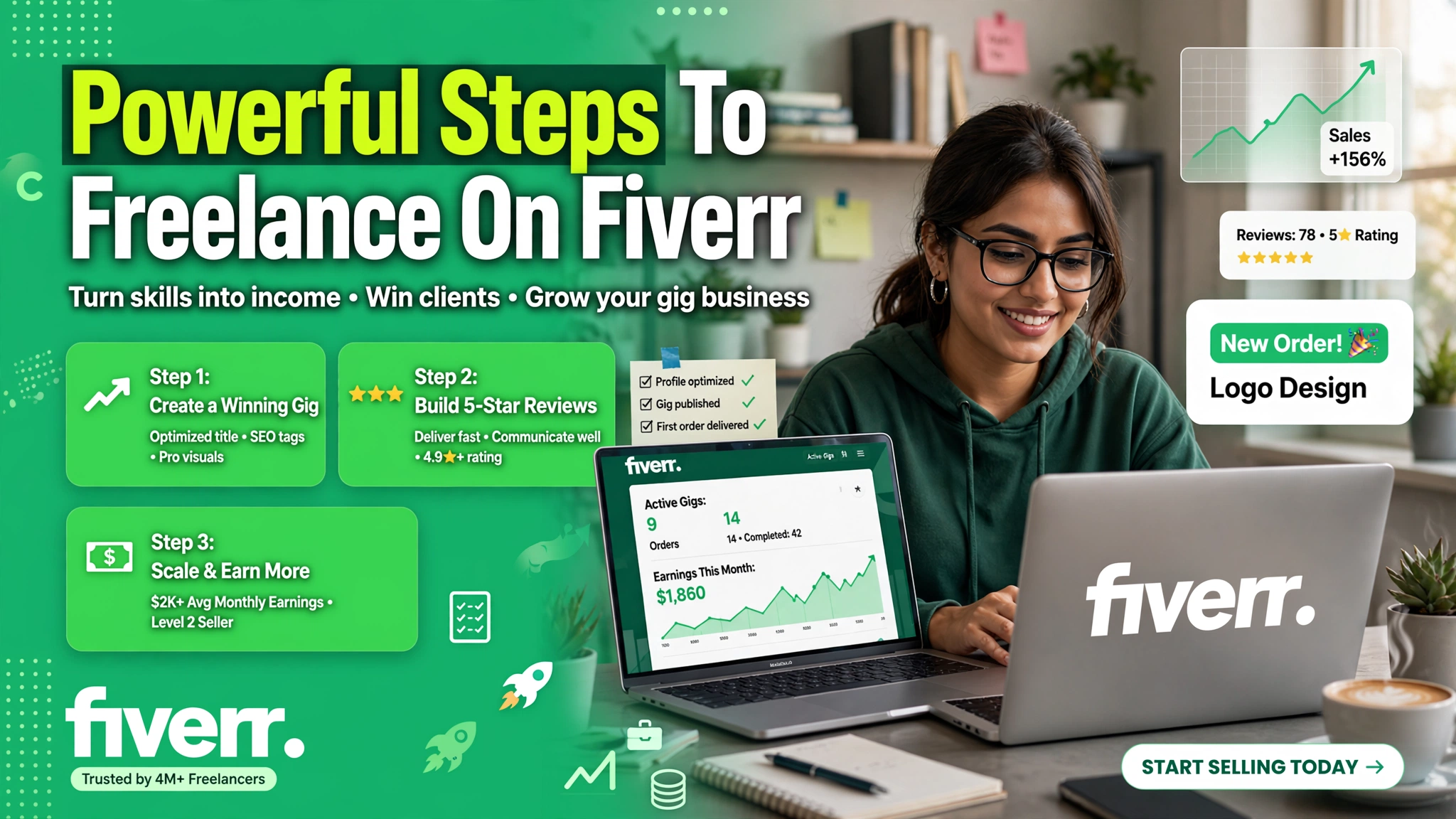
So, you’ve been itching to sell on Fiverr; after all, you’ve constantly heard sweet stories about freelancers quitting their 9-to-5s and building a full-blown six-figure business from their skills on Fiverr.
But here’s something most “how to start on Fiverr” articles won’t tell you upfront: the platform you’re joining today isn’t the one your favorite YouTuber made a tutorial about three years ago, claiming to turn a side hustle into a full-blown business, earning thousands from the comfort of his home.
As a digital marketing expert who’s helped dozens of clients (and built my own gigs) generate consistent income on Fiverr, I’ve seen what works and what crashes and burns.
One of the real secrets to understanding how the platform works is knowing how to do keyword research on Fiverr. If you ask me, the way buyers search for information and services on the marketplace is evolving. That’s equally coupled with service buyers demanding more from sellers.
Let’s shed more light on this further by referring to Fiverr’s own Q4 2025 earnings, which report annual active buyers fell from 3.6 million to 3.1 million year-over-year, a drop of roughly 13.6%, while average spend per buyer climbed to $342, indicating an increase of over 13% in the same period (Fiverr Q4 2025 results).
Here is what this major shift means: fewer buyers are shopping, but the ones who stick around are spending more and expecting more.
That single shift changes almost everything about how you should approach selling on Fiverr in 2026, and it’s the lens we’ll use throughout this guide.
That’s not all; becoming a Fiverr seller in 2026 isn’t about throwing up a gig and watching orders roll in. The platform has evolved, competition is smarter, and buyers are pickier than ever.
This guide isn’t the usual recycled advice you find everywhere. It’s a hands-on blueprint packed with first-hand insights, buyer perspectives I’ve gathered from managing campaigns, real numbers, and the counterintuitive truths that separate the top 10% from the rest.
If you’re serious about becoming a Fiverr seller, buckle up and learn exactly how to do it right.
Let’s clear something up right away: contrary to the general belief in some quarters, Fiverr isn’t a “get rich quick” platform.
It’s a marketplace where trust and reputation matter more than anything else. The freelancers who succeed are the ones who treat their profile like their storefront and their clients like gold.
You need to be at least 18 years old to create a seller account, and you’ll need to offer services that comply with Fiverr’s terms of service.
Beyond that, it’s more about showcasing your skill, professionalism, and showing up consistently.
The first step to selling on Fiverr is to simply create your account and switch to “Selling” mode.
If you’re setting up a new account, you’ll be guided through the freelancer onboarding process automatically.
And if you already have a buyer account, just click your Profile picture and select “Become a Seller”.
From there, the real work begins.
Here’s the part that trips people up: a shrinking buyer pool sounds like bad news for some, but it’s actually a filter.
Casual five-dollar gig hunters are thinning out, while higher-spending clients, the ones who actually pay invoices on time and leave five-star reviews, are sticking around and spending more per order.
Fiverr’s GMV from transactions over $1,000 grew 22.8% year-over-year, and the number of buyers spending $10,000+ annually rose 7% (Fiverr Q4 2025 results).
If you’re one of those holding off because you heard “Fiverr is oversaturated,” that’s only half true.
It’s oversaturated with generic, low-effort gigs. It’s not saturated with sellers who can solve a specific problem clearly and price like a professional rather than a hobbyist.
Your profile is your digital handshake. You’ve got to trust me when I make such a bold claim.
Your Fiverr profile is the first thing potential clients see, and honestly, it can make or break their decision to hire you.
That takes us to
When optimizing your Fiverr profile, use your real name, or at least a consistent professional identity.
A display name like “Jane D.” or “Mike S.” builds trust far more effectively than a random username that makes no sense from the get-go.
With regards to your profile picture, don’t overthink it, but don’t overlook it either.
But bear in mind that a clear, friendly, well-lit headshot works wonders. One top seller I know attributes half his early success to his smiling photo because it “made people feel like I was approachable, not just another faceless freelancer.”
You can use an AI-generated image if you don’t have a professional photo, but it must accurately reflect you or your service.
This is where many new sellers drop the ball. They write a generic bio like “I am a hardworking freelancer with experience in design.” Yawn.
Instead, think about what a buyer actually wants to know: Can you solve their problem? Do you understand what they need?
Write in plain English (it’s the platform’s primary language for communication), be honest about your experience, and don’t include contact information; Fiverr will flag it.
One successful copywriter I worked with started with a simple but effective approach: “I help busy founders write website copy that converts visitors into customers. Here’s how…”
Add specific skills and tools you actually use. If you’re a graphic designer, mention software like Adobe Illustrator or Canva.
If you’re a writer, specify whether you specialize in SEO blogs, landing pages, or email copy. Also, list all the languages you can work in along with your proficiency level.
This can open doors to clients from different regions.
To effectively sell on Fiverr, you’ve to follow
The first step and one of the most important is for you to forget “what am I good at?” And start with “what does a buyer type when they’re desperate and have a credit card out?”
Open Fiverr’s search bar and start typing a broad service like “logo design,” “voiceover,” “Shopify,” and watch the autocomplete suggestions.
Those are real, high-volume buyer queries. Your gig title should mirror that exact phrasing, not your personal job title.
A graphic designer who lists “Brand Identity Designer” is likely to be buried among the sea of gigs, while one who lists “I will design a minimalist logo and brand kit” is likely to be found easily.
Most buyers on Fiverr skim your profile in under ten seconds before deciding whether to read further.
Lead with the outcome you deliver, not your life story. One line that works well: “I help SaaS startups turn complex features into 60-second explainer scripts” sounds very specific, searchable, and instantly tells a buyer whether you’re relevant to them.
Here is another important part you must forget in a hurry when creating your Fiverr gig.
Your gig description should pre-answer the three questions every buyer silently asks: What exactly do I get? How long will it take? What happens if I need changes?
If you choose to ignore or bury that information, you’ll see buyers bounce to a competitor’s gig instead of messaging you.
This is where most beginners lose money without realizing it. Fiverr keeps a flat 20% commission on every order, extra, and tip, without tiers or volume discounts (Fiverr Help Center).
Thus, if you want to actually take home $100 from a service you render, don’t price your gig at $100; price it at $125 (target ÷ 0.80).
What about buyers? They also pay their own checkout fee on top (commonly around 5.5%, plus a small fixed fee on orders under $50), which is why your $100 gig can show up as roughly $106–$108 at their checkout.
This is worth knowing so you’re not blindsided by buyers asking “why is it more expensive than listed?”
Once your gig goes live, the first 48 hours matter more than people expect. Fiverr’s algorithm is watching your response time from day one; it’s one of the metrics behind your seller level (more on that below).
For quick and instant responses, you’re to turn on your mobile notifications. A delayed first reply on day one can cost you the order entirely.
Here’s a real-world buyer tip most sellers hardly have access to: buyers who compare five nearly identical gigs at $5, $15, $40, and $80 don’t always pick the cheapest one.
So, if you think the cheaper your gig, the more buyers troop to your gig, I am sorry to disappoint you because it most often doesn’t work that way.
Price often functions as a quality signal on Fiverr, the same way it does on Amazon.
Yeah! You read that right.
A rock-bottom price can quietly read as “inexperienced” to a buyer who’s been bruised and even burned before.
Instead of racing to the floor, compete on a tighter, more specific promise, such as “logo + 2 revisions + source files in 48 hours,” which will beat “cheap logo” hands down, almost every time, and it protects your margin from day one.
After explaining the six steps to become a seller on Fiverr, let’s now cross over to
According to the Fiverr Help Center, Fiverr evaluates six metrics daily and promotes you automatically once you clear every threshold for a level without you having to wait for a monthly cycle.
| Level | Success Score | Rating | Response Rate | Orders | Unique Clients | Earnings |
| Level 1 | 5+ | 4.4+ | 80% | 5 | 3 | $400 |
| Level 2 | 7+ | 4.6+ | 90% | 20 | 10 | $2,000 |
| Top Rated | 9+ | 4.7+ | 90% | 40 | 20 | $10,000 (manual review) |
Notice “unique clients” sits alongside order count.
For instance, five orders from one repeat buyer won’t move you up; Fiverr specifically wants proof you can satisfy different people, not just one loyal regular.
| Fee Type | Who Pays | Amount |
| Seller commission | You | Flat 20% on every order, extra, and tip |
| Buyer service fee | Buyer | 5.5% added at checkout |
| Small order fee | Buyer | Small fixed fee on orders under $50 |
| Withdrawal fee | You | Varies by payout method (bank, PayPal, etc.) |
A practical formula worth saving: Gig price = Desired take-home ÷ 0.80.
| Platform | Seller Fee | Pricing Model | Best For |
| Fiverr | Flat 20% | Buyer browses pre-made gigs | Productized, repeatable services |
| Upwork | 0–15% (variable) | Freelancer applies to posted jobs | Longer-term contracts |
| Freelancer.com | 10% | Bidding | Project-based competitive bids |
If you’d rather price one-off custom projects than productize a repeatable service, our Upwork vs. Fiverr comparison guide breaks down which model fits your skill set.
Having sat on the buying and selling sides of the Fiverr marketplace, here’s the truth: buyers don’t read every word of your gig.
They scan the thumbnail, the price, the star rating, and the first line of the description, in that order.
If your gig thumbnail looks like a stock photo template, you’re invisible before a buyer even reaches your pricing.
For better results, use a real, specific sample of your actual work as the thumbnail, not a generic graphic.
It’s the single highest-leverage five minutes you’ll spend setting up your gig.
Many “newbies” to Fiverr won’t be wrong asking, “Is Fiverr legit or right for me?”
The honest answer is yes, if it’s born in your mind that becoming a Fiverr seller is a journey, not a sprint.
It requires patience, resilience, and a commitment to delivering quality even when the orders aren’t flowing yet.
But if you have a marketable skill and are willing to put in the effort, Fiverr offers a genuine path to freelancing success.
So, what’s stopping you? Take that first step. Build your profile. Create your first gig. And remember: every top seller started exactly where you are now, with zero reviews and a whole lot of uncertainty.
The only difference is they took action.
Account setup takes minutes, but gig approval and your first sale typically take anywhere from a few days to a few weeks, depending on niche demand and how well your gig description matches buyer search terms.
No formal experience is required, but buyers can tell within seconds whether your samples look amateur or professional, so a small portfolio, even unpaid practice work, goes a long way before you launch.
New sellers can publish up to 4 active gigs; that number expands as you move up the level system, reaching 10 at Level 1 and Level 2, and 30 once you reach Top Rated status.
For most beginners, yes, Fiverr is legit; the flat 20% fee buys you access to millions of buyers without spending on ads, which is often cheaper than acquiring clients independently, provided you price your gigs to absorb the fee from the start.
Focus on response rate and rating before order volume, since Level 1 only requires 5 orders from 3 unique clients; a handful of fast-replied, well-delivered early gigs gets you there quicker than chasing volume.