Physical Address
304 North Cardinal St.
Dorchester Center, MA 02124
Physical Address
304 North Cardinal St.
Dorchester Center, MA 02124
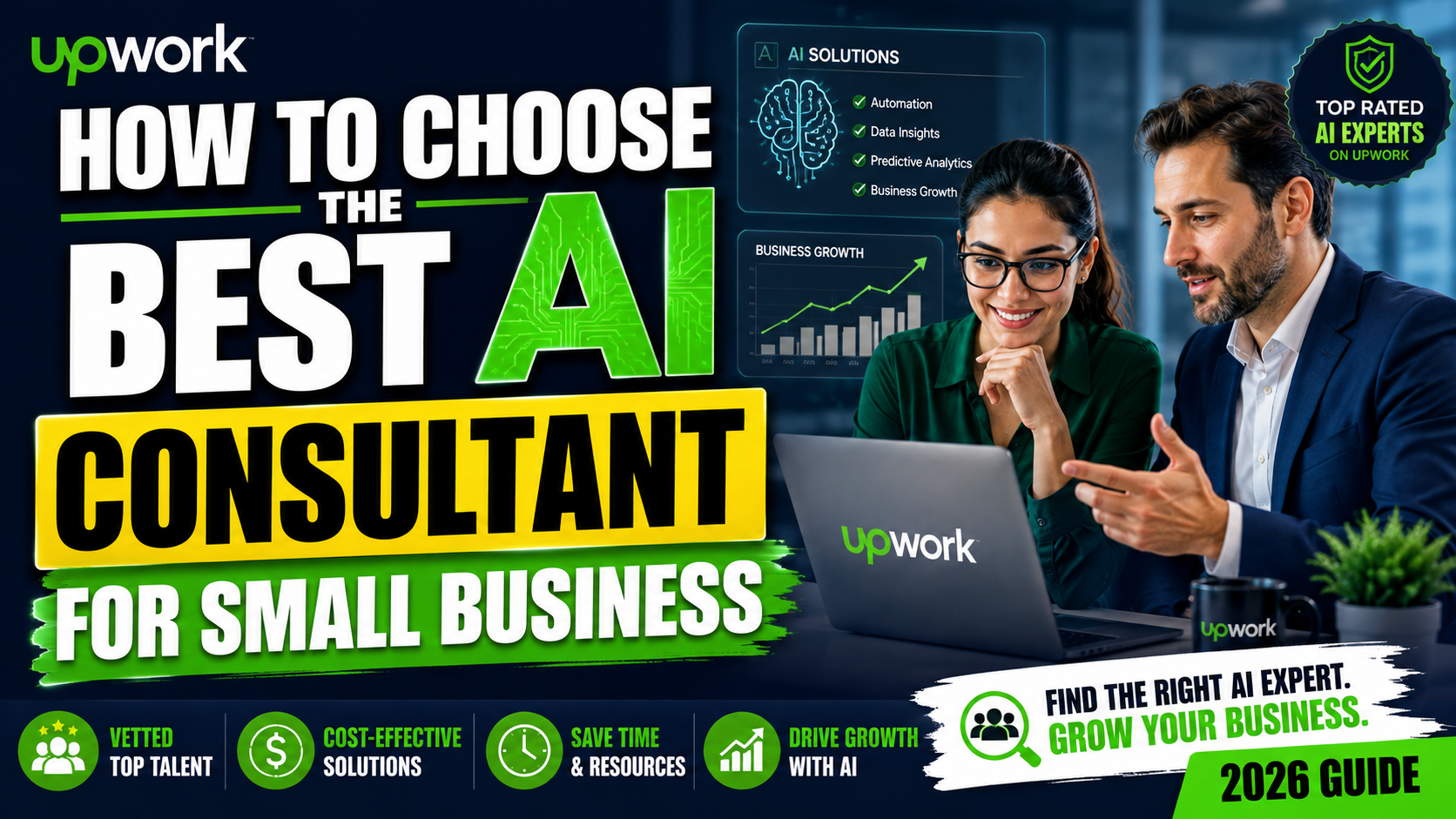
Here’s a hard truth nobody tells you before you post your first job listing: most people who hire freelancers get burned at least once.
The reason isn’t that freelancing is a scam, but that they hired on vibes instead of evidence.
I’ve run an agency specializing in recommending the right freelancer for clients for years, and I still remember the wire transfer I sent to a guy whose “AI automation portfolio” turned out to be three screenshots and a prayer.
If you’re a small business owner looking for an AI Consultant for Small Business, you’re standing exactly where I stood back then: excited, a little nervous, and one bad hire away from writing off the whole idea of AI as “not worth the hassle.”
So, let’s fix that before it happens to you. I’m going to show you the red flags I look for now, the questions that separate the real operators from the pretenders, and why Upwork’s built-in safety net makes this whole process a lot less scary than it sounds.
Look, we are in the middle of a massive shift. If you aren’t using AI to speed up your operations, your competitors are.
Right now, bigger companies are using automation to answer customer emails in seconds, sort leads while their sales team sleeps, and cut hours of manual data entry down to minutes.
Small businesses that skip this aren’t just missing a trend; they’re working harder for less money than they should be.
Nearly half of small businesses say finding qualified talent is their biggest hurdle. An AI consultant for small businesses solves that by acting as your on-demand tech department, figuring out where you are wasting time and money, and building a system to fix it.
You don’t need a full-time team to carry out some day-to-day business activities for you. What these AI consultants for small businesses are good at is finding the three or four repetitive tasks eating up your week and quietly automating them, so you get your time back and cut operational costs without hiring five new employees.
A quick small business AI readiness assessment will show you exactly where you are bleeding money. It highlights the exact tasks your team hates doing.
Once you see those bottlenecks, the solution becomes obvious. That’s why you need automation, smart systems, and an expert to build them.
Here’s what that actually looks like on the ground:
You don’t need a full tech department to get these wins. You need one person who knows what they’re doing.
When I look for a freelance AI consultant, I’m not just looking for someone who knows how to talk to a chatbot. I need a builder who can diligently look at my messy daily workflows.
They look at how your business runs today, including the hidden time-wasters and spots where a computer could do the boring parts, and build a system to handle the repetitive junk reliably.
By extension, this means you stop doing robot work and get to do human work, while your team focuses on selling and strategy instead of copy-pasting data.
Time, they often say, is money. If you are paying a VA to copy data manually from a PDF into a spreadsheet, know that you are losing cash.
A decent AI automation consultant builds a bridge between your apps by shadowing your workflow, not pitching your software.
They’ll ask what eats your day: is it invoicing, scheduling, customer replies? And target that first. The goal isn’t to “install AI everywhere.” It’s removing friction where it actually hurts, and setting up a system where the data moves on its own.
The service list is quite huge, but here is what matters to you:
It’s because doing it alone usually means months of trial and error, and expensive software subscriptions nobody ends up using.
Aside from that, they are hiring them because the tools are finally cheap enough to use. The tech isn’t just for big corporations anymore.
For instance, a small business can now afford a Zapier AI integration expert or a Make.com automation consultant. They are hiring because they are tired of doing the boring stuff themselves.
I’ll be brutally blunt with you: cold outreach and referrals from a friend’s cousin are a coin flip and a rookie mistake you’ve to avoid at all costs.
Do you know why? Following such a track gives you zero visibility into someone’s actual track record until money has already changed hands.
That’s backwards because you’ve no access to the kind of protection and structure that Upwork gives you.
The story isn’t different from googling “AI Consultant for Small Business” and picking the first result or even hiring off random forums. That’s equally risky.
Yes, and here’s the practical reason why: every freelancer on the platform has a paper trail. They all have job history, client ratings, and completed project counts; the stuff that used to be a mystery is now sitting right in front of you before you spend a dollar.
Upwork is also a great place to find AI consultants for Small Business because it’s the world’s largest marketplace.
There are more than 18 million freelancers on there. This means you have a choice. You can look at the best AI consultants on Upwork and see how they compare to the average worker.
The answer to this question is simple: you’re not limited to whoever happens to be available in your city.
On Upwork, you’re choosing from a global pool of automation experts, chatbot developers, and AI workflow specialists, all searchable by skill, rate, and rating.
Another unique thing about it is its payment system. Upwork holds the money in escrow. You don’t pay the freelancer until you approve the work. If they disappear or do a bad job, you have recourse.
Also, Upwork has brought in new tools to help you find the best AI consultants faster. Their AI agent, Uma, can actually shortlist the best candidates for you based on your job post.
If you are a non-technical founder, don’t worry because this is a lifesaver you’ve been waiting for. You don’t have to guess who is good; the AI helps you find the top 1% of talent.
Instead of just one quote from one person, you can line up five proposals side by side, check verified reviews from past clients, and see exactly what similar businesses paid for similar work.
With this, you can see everything, ranging from the freelancer’s work history to their rating and their client testimonials. All of these are right there on the page.
That kind of transparency didn’t exist when I started my agency, and it would’ve saved me a lot of money.
This is the part most people rush, and it’s exactly where things go wrong. My friend, you’ve to be strict. If you aren’t strict, you will get cheated.
To be on the safe side, look for a mix of technical chops and plain-English communication. If they can’t explain what they’re building without ten acronyms, that’s a problem, not a flex.
As an expert who hires freelancers for clients, my chosen seller needs to be practical, not theoretical. I don’t care if they have a Ph.D. if they can’t connect a simple API.
Be prepared to ask for real examples. Not “I’ve done AI work before.” Watch out for the actual before-and-after numbers.
Be warned as well. A freelance AI consultant hourly rate that seems low but comes with zero verifiable results is not a deal. It’s a gamble wearing a discount.
Another important consideration is for you not to read the text they wrote and stop there. Look at the reviews the platform verified.
See if they have done similar work before. If they say they are an AI solutions architect for small businesses, they should have a project in their portfolio that shows they did something similar for at least a company your size.
If they’re serious, at minimum, they should be comfortable with automation tools like Zapier, n8n, or Make.com, common CRMs, and whichever AI models fit your use case.
If they only know one tool and try to force every problem into it, keep looking.
They should also know how to use the specific AI models you care about, like ChatGPT or Claude.
Almost always, yes. Automation is where the real money is saved.
Business process automation is usually 80% of the value small businesses get from AI work, so someone who’s built real automations beats someone who’s only “experimented” with AI.
So, look for a Make com automation consultant on Upwork or a Zapier AI integration expert. They know how to connect the dots.
This is a bonus, not a requirement. For example, if you run a real estate agency, it’s great to find out if they have worked with agents before.
That’s why a great generalist who asks smart questions can often outperform a niche specialist who assumes they already know your business.
Having said that, if they are a skilled AI automation consultant, they can learn your industry quickly. Thus, the suggestion is for you to focus on their technical skills first.
Money is always the sticking point. Let’s break it down so you aren’t surprised.
Here is the key driver of prices. The cost of hiring an AI consultant depends on the complexity, how much custom development is involved, and the consultant’s experience level.
These are the major factors that determine the price.
Are you just building a simple chatbot? Or are you automating your entire payroll system?
Put in plain English: the more complex the project, the higher the rate, which ranges from $60/hr to $150/hr depending on the skill.
But remember, Upwork is carefully built to help you manage this.
For your first project, start with a fixed-price project. Here is why: you give the freelancer a specific task. You agree on a budget. Upwork holds the money. When they show you the finished work (like a Zapier setup), you release the money.
This protects you from a freelancer saying “I worked 10 hours on this” when they only spent 2 hours doing it.
Milestones are your friend.
Just start small. Look at the average small business AI implementation cost.
Your goal isn’t to build or automate your entire business on day one. Pick one painful process and fix it. Your goal is to test if this person is reliable.
I recommend a small business AI readiness assessment. This is a small paid project where the consultant looks at your business and tells you where AI can help. Budget around $300 – $500 for this initial consultation.
Once they prove they know what they are talking about, you can scale up to the big projects.
You are the boss here, and there’s no iota of doubt about that. So, act like one, keeping in mind that screening questions are where you separate operators from talkers.
Ask these questions during the interview.
If they can’t break it down for an eighth grader, they either don’t fully understand it themselves, or they’re hiding behind jargon on purpose. Walk away.
They need to be able to explain the plan to you in plain English. You are paying them to make your life easier, not more confusing.
Ask for specific numbers. Did they cut costs for the previous client by 20%? Did they save 15 hours of manual work a week? Get proof.
This is also very important. Your customer data isn’t a plaything. A serious AI integration consulting professional should have a clear answer for how they store and access such vital information.
That’s not all. If you are giving them access to your customer data, you need to know how they will protect it. Ask them about data security protocols.
It’s common knowledge that automations break and software updates. A consultant who disappears the day the project ends is leaving you and your business stranded.
Find out if they are available for maintenance after the project is done. If they build a custom AI chatbot developer Upwork tool, who fixes it when it glitches?
This is the gut-check section. It’s time for us to split the good from the bad.
Before getting to the red flag checklist, these are obvious red flags that you don’t need a soothsayer to tell you to bail. “I can do everything.” “It will be ready tomorrow.” “I need 50% upfront via crypto.” “Let’s move the project over to Telegram,” etc.
Red Flag Checklist:
If you’re serious about hiring a good freelance AI automation consultant, you’ve to be disciplined enough to read past client comments, not just star ratings.
Look at the names of the clients. If they have worked with big companies, that’s a plus. Also, look at the review language. Are the reviews specific? Or are they all just “Great guy” or “Good work”?
The beauty of doing this is that repeat clients are one of the strongest signals you’ll find, since businesses don’t rehire people who wasted their money.
At this point, you’ve got the framework. The last step is actually posting the job and letting the system work for you.
Begin by writing a clear, specific job post, because vague listings attract vague freelancers.
For instance, when you post your job, be specific. Don’t say “I need an AI expert.” Say “I need a Make.com automation consultant to connect my Google Sheets to my Mailchimp. This is a fixed-price job with milestones.”
One important reason for using milestones is that Upwork’s milestone system breaks the project into checkpoints, so you’re only releasing payment as work gets delivered, not all upfront.
Their payment protection and dispute resolution exist specifically for situations where things go sideways, which means you’re not carrying all the risk alone anymore.
If your project is complex or business-critical, browsing Upwork’s Pro tier talent pool can save you time by surfacing pre-vetted, higher-tier freelancers from the start.
You can also use Upwork’s AI tools to help you draft that perfect job post. Let the AI do the heavy lifting to find the right talent for you.
Find and hire your AI Consultant for Small Business on Upwork →
Still not sure what you actually need? Here are the concrete ways an AI consultant can help you today.
You don’t need to pay someone to answer “Where is my order?” at 2 AM. A chatbot can handle that. A custom AI chatbot developer can set this up in a day.
With this, you can automate your email sequences. Plus, you can find a Zapier AI integration expert who can set up a system that sends a welcome email to every new sign-up automatically.
Do you have a blog? This AI workflow can draft, tag, and schedule content faster, freeing your team for the work only humans can do.
You just have to edit, give it the human touch, and publish. Think of the time you save.
It allows AI to look at your sales data and tell you what your best-selling product will be next month based on trends. It’s like having a crystal ball for your business finances.
The relationship doesn’t stop at the hire. You have to manage the project.
You don’t have to be vague in this. “I want to save time” is a bad goal. While “I want to reduce the time it takes to generate an invoice from 15 minutes to 2 minutes” is a good goal.
How will you measure if the project worked? Is it time saved? Money saved? Fewer customer complaints? Define this with the consultant before they start.
From all you’ve gathered so far, it would be out of place for you to go dark and wait for a miracle after placing an order.
Regular messages keep the project on track. Ask questions early instead of after something breaks.
Yes. I cannot stress this enough. Test them. Give them a tiny task. If they handle it well, give them the big one. This is how you find a reliable AI consultant for a small business without burning your whole budget.
Bigger companies aren’t winning because they’re smarter. They’re winning because they’ve automated the boring stuff and redirected that time toward growth.
A capable AI Consultant for Small Business puts that same advantage within reach, without the enterprise budget.
The task here is simple: match the person to the project, not the other way around. Start small, verify everything, use Upwork’s built-in protections, and scale up once you’ve found someone who actually delivers.
Don’t forget that you are looking for a partner, not just a code monkey. The right AI Consultant for Small Business is out there, and Upwork makes finding them safe and easy.
That’s the whole system; there’s no guesswork required.
Post a job with specific details on what you need to automate. Use Upwork’s AI tools to help you write the job post and shortlist candidates.
Look for experience with specific platforms like Zapier or Make, strong client reviews, and a willingness to work with milestones. Avoid those with generic skills who aren’t good at communicating.
One hundred percent. The small business AI implementation cost usually pays for itself quickly in saved labor hours. If a consultant can save you 10 hours a week, that is a massive win for your bottom line.
That is exactly who they are for. You don’t need to know how the tech works. You just need to know what results you want. The consultant handles the rest.