Physical Address
304 North Cardinal St.
Dorchester Center, MA 02124
Physical Address
304 North Cardinal St.
Dorchester Center, MA 02124
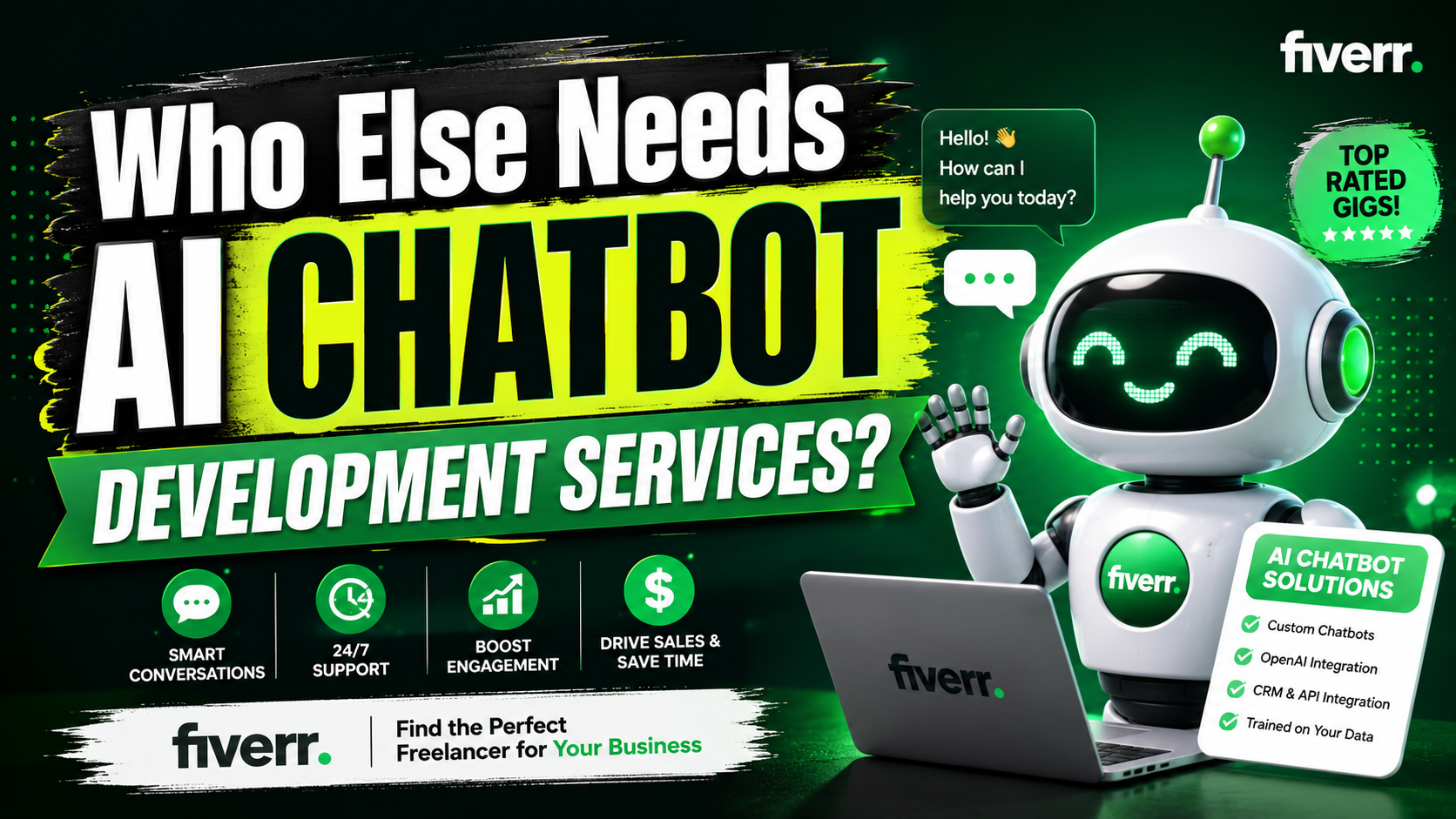
Why do so many business owners spend weeks chasing the “right” developer, only to end up with a chatbot that can’t answer a simple question correctly?
It’s a frustrating cycle, and if you’ve lived through it, you already know how expensive a bad hire can feel, not just in dollars, but in customer trust.
Here’s the thing: AI chatbot development services aren’t some far-off tech luxuries anymore. They’re becoming a normal part of how businesses handle support, sales, and lead generation around the clock.
Customers now expect an instant answer at 2 a.m., not a “we’ll get back to you in 24-48 hours” auto-reply we used to hear.
And that shift is exactly why so many founders and business owners are turning to Fiverr to find AI chatbot freelancers who can build something that actually works.
So, if you’re tired of clunky bots, missed leads, or developers who overpromise and underdeliver, stick with me. In this post, you’ll learn how AI chatbot development services actually work, what separates a good developer from a risky one, how much you should realistically budget in 2026, and how to hire the right person on Fiverr without gambling your budget on guesswork.
Let’s break that down in plain terms so you’ve a better understanding of what we are focusing on in this blog article.
AI chatbot development services cover the process of designing, building, training, and deploying a chatbot that can hold a conversation, answer questions, and complete tasks, like booking appointments or recommending products. Without a human typing every response.
The truth is, most businesses don’t need a chatbot because it’s trendy. They need one because their team is drowning in repetitive questions like “What are your hours?” “Where’s my order?” “Do you ship internationally?”
A well-built chatbot handles those questions instantly, freeing your team to focus on the conversations that actually need a human touch.
Stretching what it does a lot further, modern versions go far beyond old “click this button” bots.
They use large advanced language models like GPT-4 or Claude, retrieval systems, and careful prompt engineering to understand natural language so the bot can answer product questions, qualify leads, book appointments, or hand complex issues to a human without sounding robotic.
This means visitors can ask questions in their own words, and the bot gets it, without rigid commands or “please rephrase your query” nonsense.
The truth is, in business, speed and effective product and service delivery win any day. To buttress this claim, IBM reports that businesses using smart bots cut support costs by up to 30%.
Those are numbers speaking for themselves. Businesses that implement AI chatbots see:
Just imagine having a support team that works every hour of every day without overtime pay. Chatbots handle basic questions instantly, freeing your human team to tackle complex issues.
Many businesses report slashing support ticket resolution times by 60% or more.
Visitors who get immediate answers are far more likely to purchase than those who’re asked to wait or return for answers in 48 hours.
AI chatbots can proactively offer help, recommend products, and even guide buyers through checkout. The result? More closed deals and happier customers.
It’s common business knowledge that hiring and training support staff costs serious money.
But a well-built AI chatbot handles thousands of conversations simultaneously for a fraction of the cost. Most businesses recoup their investment within months.
Another benefit of deploying a custom AI chatbot is that every conversation your bot handles generates data.
You’ll learn what customers ask about most, where they get stuck, and what they really want. This intelligence helps you improve everything from your website to your product offerings.
Every chatbot you see out there is built with its unique features and functions, and knowing these matters more than most people realize before they hire someone.
Put simply, rule-based bots are like vending machines; they only follow strict decision trees.
Rule-based bots follow a fixed decision tree, “if this, then that” logic, and are fantastic for simple, predictable questions, but they break the moment a customer phrases or asks an unexpected question.
It’s Best Suited For: Simple FAQ handling, appointment booking, basic order status checks.
Pros: It’s cheap to build and easy to understand.
Cons: It’s rigid because it can’t handle unexpected questions, and can frustrate customers who want natural conversation.
A natural language processing chatbot adds some layers of flexibility by using natural language processing to understand intent, even when the wording varies, which makes conversations feel more natural.
They recognize synonyms and can handle basic conversational flows.
It’s Best Suited For: Businesses with moderate complexity but limited budgets.
Pros: It’s more flexible than rule-based and handles common variations well.
Cons: It still struggles with complex or multi-part questions.
Large Language Model bots (the ones built with ChatGPT-4, Claude, or Gemini, or similar models) go a step further, understanding context and intent beautifully, handling complex questions, remembering customer conversation history, and generating original responses that sound natural.
It’s Best Suited For: Any business wanting truly helpful, human-like interactions.
Pros: This chatbot is incredibly flexible, handles complex queries, and improves with more data.
Cons: It’s more expensive and requires careful prompt engineering to prevent errors.
Most businesses in 2026 benefit from custom AI chatbot development that combines an LLM with retrieval-augmented generation so answers stay grounded in your actual documents and policies.
So, if your business gets a wide variety of customer questions, a custom GPT chatbot development approach will almost always outperform a basic rule-based script.
You know that frustration when you’re stuck in an automated phone tree, don’t you? I mean that era of “Press 1 for sales, press 2 for support…”
That’s same way the same way rule-based bots feel to customers.
Once they get stuck, their simplest route is to give irrelevant answers.
When a basic bot fails,
Good enough, generative AI avoids this by actually understanding context and keeping the conversation flowing naturally.
This is where things get exciting. Modern AI chatbots don’t just answer questions; they drive business results.
Another good feature is that an AI chatbot doesn’t take weekends off and doesn’t get tired at hour eight of a shift.
Let’s further explain how it performs this magic on your business.
When customers feel heard and helped, they stick around. AI chatbots provide immediate, consistent, accurate responses every single time. It means you no longer have to worry about moody agents or long wait times. Just dependable support that builds trust.
One of our ecommerce clients saw customer satisfaction scores jump by 42% after implementing a custom AI chatbot. Their support tickets dropped by half. People actually complimented the “helpful 24/7 assistant.”
Here’s a scenario that plays out every night: Visitors browse your site at midnight. That’s probably when you’re busy sleeping and snoring.
Some of them are there because they’ve questions about pricing or features. Without an AI conversational chatbot service, they bounce without ever returning, but with one, they get answers and convert.
AI chatbots can:
An AI customer service chatbot development project handled by an experienced developer who understands both the technology and your brand voice creates a bot that feels like an extension of your team.
Poorly built bots- I mean the type that might promise a 90% discount by mistake damage trust. On the other hand, solid ones free your support staff to handle the high-value conversations that actually need a human, answer customers’ enquiries accurately, and in your brand’s voice, without making things up.
That accuracy is what prevents a flood of “the chatbot told me something wrong” tickets from landing back on your support team’s desk.
We reviewed dozens of gigs offering AI chatbot development services, looked at portfolios, checked recent client feedback, and tested sample deliverables where possible.
Generally speaking, the goal was simple: judging AI chatbot freelancers comes down to a few measurable things: how accurate their bot’s responses are, how fast they can integrate it into your existing systems, and how transparent they are about their process from the first message.
A strong developer should be able to explain, in plain language, how they reduce hallucinations (when an AI confidently gives a wrong answer), how they structure your knowledge base, and how cleanly their code integrates with your existing tools.
Look for developers who respond quickly during the hiring stage; that’s often a preview of how responsive they’ll be after you hire them.
The top sellers offered clear AI chatbot post-production services, meaning they stuck around for two weeks after launch to squash any weird glitches for free. Fast reply times under three hours were a massive green flag.
A clear revision policy and a stated bug-fix window of, say, 14 or 30 days post-delivery protects you if something breaks after it goes live.
Anyone can claim to be an expert at anything online. We checked their actual GitHub code repositories to verify their Python skills and coding habits.
We also dug deep into their Fiverr reviews, looking specifically for feedback from other business owners and specific reviews from clients who had integrated the bot into their daily operations.
Now, it’s time to get into the real deal. This is where you’ll learn exactly how to find and hire a developer who can actually deliver results.
As an agency owner specializing in recommending and hiring freelancers for clients, I’ve tried them all. Upwork, Toptal, Freelancer- you name it. Fiverr consistently stands out for AI chatbot development services.
Fiverr is a go-to freelancing platform for both buyers and sellers of freelance services because it’s grown into one of the most active marketplaces for AI chatbot developers, and for good reason.
You can compare gig pricing, seller levels, response times, and reviews side by side, all before spending a dollar.
That kind of visibility is hard to get anywhere else, especially compared to cold-emailing agencies that won’t quote you a price until after a “discovery call.”
In addition to that, Fiverr gives you fixed-price packages, buyer protection, and a huge pool of specialists.
Which means you can start small with a prototype, test the working relationship, and scale once you are happy.
Fiverr Pro and Level 2 sellers add an extra layer of screening. For most startups and small businesses, this combination of speed, price transparency, and talent density beats both pure agency quotes and endless Upwork interviews.
The answer is simple. They need to know how to connect the “brain” to the “memory.”
The brain is the LLM (like OpenAI), while the memory is a vector database. If your developer does not understand how to link these two pieces, your bot will certainly be useless.
A capable developer should be comfortable with prompt engineering, API integrations, and connecting your chatbot to the platforms you already use, i.e your website, your CRM, your e-commerce store.
For anything beyond a basic FAQ bot, look for experience in:
Python
This is the language of AI. Your developer should be fluent in Python and familiar with popular libraries.
LangChain
This framework helps build applications with language models. It’s become essential for serious chatbot development.
Vector Databases
These are critical for storing and retrieving information efficiently. Developers should know Pinecone, Weaviate, or similar tools.
API Integration
Your bot needs to connect to services like OpenAI, Claude, or Gemini. Knowledge of API authentication, rate limiting, and error handling matters enormously.
Prompt Engineering
This skill separates average developers from great ones. A skilled prompt engineer crafts instructions that get reliable, accurate responses from the AI model.
Data Privacy Knowledge
Your developer should understand how to handle sensitive data. Encryption, access controls, and compliance with regulations like GDPR should be second nature.
A polished portfolio doesn’t guarantee quality. Here’s what to look for when hiring AI chatbot development services:
Live Demos
Ask for a live demo link to a working bot they’ve built, not sheer screenshot. Test it yourself and pay attention to how the bot handles an unexpected question. That’s usually where the quality gap between developers shows up fastest.
Client Testimonials
Look for specific feedback about the collaboration process and results. Vague praise is less valuable than detailed accounts.
Project Complexity
What kind of bots has such an AI chatbot developer built before? Basic FAQ bots are easy to build, while complex enterprise integrations require real skill.
The interview process matters, and how you handle it goes a long way in determining the quality of project you get. Here are questions that separate real experts from pretenders:
“How do you handle LLM hallucinations?”
A good developer should discuss prompt engineering, retrieval-augmented generation, and fallback strategies.
“How Do You Handle Prompt Injection”
Ask them how they handle “prompt injection.” This is a sneaky hack where users type hidden commands to make the bot spit out your private system instructions. If the developer looks confused, walk away immediately.
“What’s your process for training the bot on business-specific data?”
They should explain how they prepare documents, handle formatting, and test accuracy.
“How do you manage API costs?”
Experienced developers optimize API usage to keep ongoing costs reasonable.
“What happens if the bot breaks after launch?”
They should discuss monitoring, maintenance, and bug-fix policies.
“Can you share a challenging project you’ve solved?”
This reveals their problem-solving abilities and experience with real-world obstacles.
Lastly, ask them how they handle data privacy, what’s included in the price versus what costs extra, how many revisions you get, and what happens if the bot needs fixing after launch.
Their answers will tell you almost everything you need to know before you commit.
Watch out for these warning signs:
Fake Demos
Some developers use demo videos rather than live links. Always request to see a live demo test.
Vague Tech Stacks
If they can’t clearly explain what tools and platforms they’ll use, they might not know what they’re doing.
No Maintenance Plan
A developer who disappears after delivery leaves you stuck with future problems.
Unrealistic Promises
If a gig just says “I will make you a smart bot” within a day for 100 dollars, run the other way. Nobody can deliver a perfect, complex AI chatbot in 24 hours for $100. Look for a seller who is realistic in their promises.
Inconsistent Communication
If they’re slow to respond during the sales process, they’ll be worse after you’ve paid.
These are common warning signs of a rushed or inexperienced hire.
| Feature | muneebashraf524 (Bitech Digital) | ntech_dev (N Haider) |
| Fiverr Status | Vetted Pro And Top-Rated | Top Rated Seller |
| Experience | 6+ years full-stack & AI | 3+ years AI-specific (700+ projects) |
| Starting Price | $120 | $110 |
| Turnaround | From 7 days | From days |
| Key Tech | TypeScript, Python, React, Node.js, AI APIs | OpenAI, Claude, Gemini, Grok, Azure AI |
| Industries Served | E-commerce, apps, startups | SaaS, health, finance, education, and real estate |
| Revisions | 2 revisions | 1 revision (Basic) |
| Member Since | Available on profile | July 2020 |
| Profile Reviews | Verified positive reviews | 389 gig reviews — 5.0 stars |
Bitech Digital is a Vetted Pro and Top-Rated seller that has been a member since May 2018 and bills itself as a web solutions agency capable of transforming your business with intelligent web solutions. They are an experienced full-stack software development agency that has successfully delivered 500+ website development projects, with a blend of cutting-edge AI technology and expert full-stack and frontend development.
The agency has already amassed 407 glowing reviews and completed hundreds of orders, with exactly 7 orders currently in queue as of this writing.
Thus, if you’re looking for an AI chatbot designer who can handle end-to-end development, from front-end interfaces to back-end logic and AI integration, this is worth exploring.
The gig covers AI website development, AI chatbot creation, AI web applications, and mobile app development using Flutter (for both iOS and Android).
Bitech Digital specializes in combining responsive design with AI-powered functionality, making him a solid choice for businesses that want a complete product, chatbot included, rather than just a standalone bot.
From what’s publicly available on his profile, buyers have appreciated the clean delivery and professional communication.
Here’s what real buyers have said:
“Professional, skilled, and reliable. The mobile app was delivered on time with great attention to detail. Communication was excellent, and the final product works flawlessly. I will definitely hire again.” — Verified Fiverr Buyer.
“Super happy with my AI app. I love how futuristic the design feels; it’s something I’m proud to show off. If you need an app that truly stands out, this is your seller.” — Verified Fiverr Buyer.
One point to keep in mind: Sourov’s profile is more broadly focused on mobile and web app development alongside AI chatbot work.
If your sole need is a highly specialized, LLM-heavy chatbot with RAG capabilities, you’ll want to clarify scope with him before ordering to ensure the project is in his core wheelhouse.
That said, for businesses needing an integrated website and chatbot package, his versatility is a genuine advantage.
What he delivers: The deliver Full-Stack Development – Complete backend infrastructure with robust databases, APIs, and security
Frontend Excellence – Stunning, responsive user interfaces using React, Vue.js, and modern frameworks. AI Integration – Smart chatbots, personalization engines, and predictive analytics
Third-Party Integrations – Seamless connections with Stripe, Twilio, and essential business tools
Starting Price: $120 | Turnaround: From 7 days
People Also Read: 6 Fiverr Pinterest Marketing Experts For Increased Traffic And Visibility
N Haider is a Top-Rated seller and a true veteran of the platform, having been a member since July 2020.
He boasts an impressive 389 reviews and over 700 completed projects, maintaining a consistently busy queue with high demand from repeat clients.
Aside from that, if you want a battle-tested AI chatbot expert on Fiverr, N Haider (ntech_dev) is a hard name to look past.
With a 5.0-star rating across 389 verified gig reviews, a Top-Rated badge, and over 700 completed projects across more than 3 years specializing in AI, this seller has built a track record that’s genuinely difficult to fake.
N Haider’s specialty is building custom AI-powered websites, SaaS applications, and intelligent chatbot systems using the most current large language models available:ble, OpenAI’s GPT-4, Anthropic’s Claude, Google’s Gemini, Grok, and Microsoft Azure AI.
He builds RAG-based chatbots trained on your own business data, meaning your bot doesn’t just regurgitate generic responses; it answers questions based on your actual products, documents, and knowledge base.
Here’s what real buyers have said:
His gig currently starts at $150 for the Basic package (Simple AI Integration, 3-day delivery, 1 revision) and scales up for more complex SaaS applications and multi-feature builds.
He’s been a Fiverr member since July 2020 and maintains an average response time of around 5 hours.
Here’s what real buyers have said:
“Nasim exceeded expectations with exceptional code expertise and a deep understanding of the project goals. They delivered clean, scalable, well-structured work, proactively caught edge cases, and suggested smart improvements that elevated the final result. Communication was clear and reliable.” — drphillip, Repeat Client, Canada
“Rating 120/100. The delivery is superb. Highly recommended.” — marketingcfm, Singapore
And in the spirit of balanced reporting, one buyer left a 4-star rating (out of 389 reviews, only 2 are 4-star and none lower):
“Good work, overall.” — jyothimani, India (4 stars)
That 4-star note suggests that while delivery quality is consistently high, some buyers may want more polish or communication detail on longer-running projects. Worth discussing expectations upfront if your project is complex.
Industries Served: His services are for Health, Finance, Education, Entertainment, Real Estate, E-commerce, Travel, Productivity SaaS, and more.
What he delivers: Nasim delivers AI chatbots and virtual assistants, AI SaaS platforms, LLM integration (OpenAI, Claude, Gemini, Grok), RAG-based bots, payment gateway integration, scalable architecture, and AI website development.
Starting Price: $150 | Turnaround: From 3 days | Member Since: July 2020 | Reviews: 389 (5.0 stars)
Fiverr Pro sellers go through an additional vetting process, which makes them a solid option for more complex, enterprise-level projects. It’s not a guarantee of perfection, but it does narrow the field to freelancers with a proven track record.
Yes, I know this may come as a surprise to many people. Plenty of AI chatbot development company-level talent freelance on Fiverr, often at a lower price point because they don’t carry an agency’s overhead.
Some of them claim they’ve done the agency thing and prefer flexibility and independence.
We’ve seen Fiverr developers deliver work that matches or exceeds agency quality. The difference comes down to management.
Agencies provide project managers who handle coordination. Freelancers require you to manage the process more directly.
The trade-off is that you’ll need to do a bit more of your own vetting instead of relying on an agency’s account manager to filter for you.
The pricing gap is significant.
Fiverr:
Upwork:
Agencies:
Fixed-price works beautifully when you know exactly what you want. You agree on deliverables upfront, without any bit of surprises.
Hourly makes sense for exploratory work or ongoing maintenance. With this model, you pay for time, not outcomes.
For most startups and small businesses, fixed-price Fiverr gigs offer the best value. You’re in control of costs and know what you’re getting.
Let’s get a lot more practical and talk about money.
The spread is enormous:
Basic FAQ Bot: $100-$500
Mid-Tier GPT Bot: $500-$2,500
Custom LLM-Powered Agent: $2,500-$10,000+
A simple FAQ bot, built on a rule-based or basic NLP framework that can be live for a few hundred dollars, is far cheaper than a fully custom LLM-powered agent that reasons over your documents, remembers context, and takes actions costs more because of the extra engineering and testing required.
The price gap reflects the extra work involved in prompt engineering, data structuring, and API integration for the more advanced build.
A budget option can work fine for a simple, low-stakes bot. But if the code is poorly structured or the developer skips proper testing, you may end up paying another developer later just to untangle what went wrong.
We’ve seen clients spend $100 on a bot that produces poor responses, broken integrations, and constant errors. They eventually ended up paying another developer $1,500 for a proper build.
Weigh the upfront savings against the cost of a possible do-over, bearing in mind that a $30 bot will likely hallucinate, anger your customers, and break every time you update your website.
Let me break down what you get at each level:
$100 Gig:
$5,000+ Build:
A $100 gig usually covers a template-based setup with limited customization. A premium agency build typically includes custom architecture, extensive testing, ongoing support, and deeper integration work — the price reflects the scope, not just the label.
Here’re hidden costs that catch people off guard:
API Fees: Every conversation your bot has costs money. OpenAI charges per token. Heavy usage adds up fast.
Vector Database Hosting: If your bot uses retrieval-augmented generation, you’ll pay $20 a month for Pinecone database hosting.
Maintenance: Your bot needs updates. Sometimes the underlying AI models change. Sometimes your business data changes. Factor in ongoing costs.
Hosting: Most bots need cloud hosting. This is typically cheap, but it’s an ongoing expense.
These add-ons are easy to overlook until the first invoice arrives. However, the good news is that many freelancers offer optional maintenance packages so the bot stays accurate as your products and policies change.
Timelines vary widely based on the general complexity of your project:
Simple bot: can take 3-7 days
Medium complexity: can take 1-3 weeks
Complex enterprise bot: can take 2-6 weeks
The biggest variable is your readiness. If you provide your AI chatbot developer clean training data and clear requirements, the process flies. Also, if you’re figuring things out as you go, expect to witness some delays.
Most experienced AI chatbot integration service developers can connect your bot to common platforms like Shopify and WordPress without much friction. The key is to establish proper communication with the seller.
Before hiring, confirm:
A custom or less common CRM may take extra development time, so it’s worth confirming compatibility before you hire.
A trustworthy developer will explain how customer data is stored, whether it’s encrypted, and how they handle compliance requirements like GDPR if you serve customers in the EU.
If a developer brushes off this question, treat that as a warning sign.
This is critically important and often overlooked by most business owners looking to hire AI chatbot development services.
The point is that this aspect of the contract should be spelled out clearly in writing before work begins. In most cases, you should retain full ownership of the source code, custom prompts, and API keys once the project is delivered and paid for.
The quality of your bot depends entirely on the quality of your data. Here’s what you should prepare in advance:
Product Information
Company Information
Policy Documents
Support Knowledge Base
Marketing Content
The more organized this material is before you send it over, the faster and more accurate your chatbot’s training will be.
A clear brief makes all the difference. It should contain the following features:
Business Context
What do you do? Who are your target customers? What problems do you solve?
Specific Goals
What should the bot accomplish? Is it more sales, fewer support tickets, better customer satisfaction? List them out for the chatbot developer.
Brand Voice
Use adjectives and a few relevant phrases to describe your brand’s tone. Is it professional, friendly, authoritative, quirky?
Sample Conversations
Show what successful interactions should look like and equally include examples of good and bad responses.
Must-Have Features
List what’s essential versus what’s nice to have.
Integrations Required
Specify exactly what systems the bot needs to connect with.
Some developers offer this as part of the package; others expect you to hand over clean, organized data.
On your part, ask directly before hiring anyone, since disorganized source material is one of the biggest reasons chatbots give confusing or incorrect answers.
Ultimately, investing in the right AI Chatbot Development Services is one of the smartest moves you can make for your business in 2026.
Whether you choose Sourov for his comprehensive full-stack approach and unlimited revisions, or N Haider for his deep expertise in LLMs and SaaS monetization, you are guaranteed to work with vetted professionals.
Don’t let your leads go cold while you are offline. Take the plunge, message your chosen developer, and watch your business transform into a 24/7 sales powerhouse.
For a small store on a tight budget, a no-code or low-code chatbot setup (using tools like ManyChat or Voiceflow) is usually the most practical starting point. These options are faster and cheaper to build than a fully custom LLM agent, while still handling common questions about orders, shipping, and returns. As your store grows, you can upgrade to a more advanced, custom-trained bot. Start by listing your top 10 most-asked customer questions; that list becomes the foundation of your first bot.
Experienced developers reduce hallucinations by grounding the chatbot’s answers in your actual business documents, rather than letting it generate answers purely from general training data. This is often done using a technique called retrieval-augmented generation, which pulls facts from your knowledge base before responding. No system is completely error-free, but a well-built bot with proper guardrails makes false answers far less common. Ask any developer you’re considering how they specifically handle this before you hire them.
Most professional AI chatbot developers set up a way for you to update information yourself, either through a simple dashboard or by sending updated documents for retraining. Ask about this workflow before the project starts, since some setups are far easier to update than others. If your prices or policies change often, prioritize a developer who builds an easily editable knowledge base. Otherwise, you may end up paying for a developer’s time every time something small changes.
This varies by gig, so check the listing carefully before ordering. Some developers include a limited amount of API usage in their price, while others expect you to set up and pay for your own API key directly with OpenAI or another provider. Paying for your own key generally gives you more control and transparency over ongoing costs. Always clarify this detail upfront so there are no surprise charges later.
A one-time build works well if your chatbot’s needs are simple and unlikely to change much. A monthly retainer makes more sense if your business updates frequently, adds new products often, or wants ongoing improvements based on real customer conversations. Many businesses start with a one-time build to test the waters, then move to a retainer once the chatbot proves its value. The right choice really comes down to how often your business, and your chatbot’s job, is likely to change.